
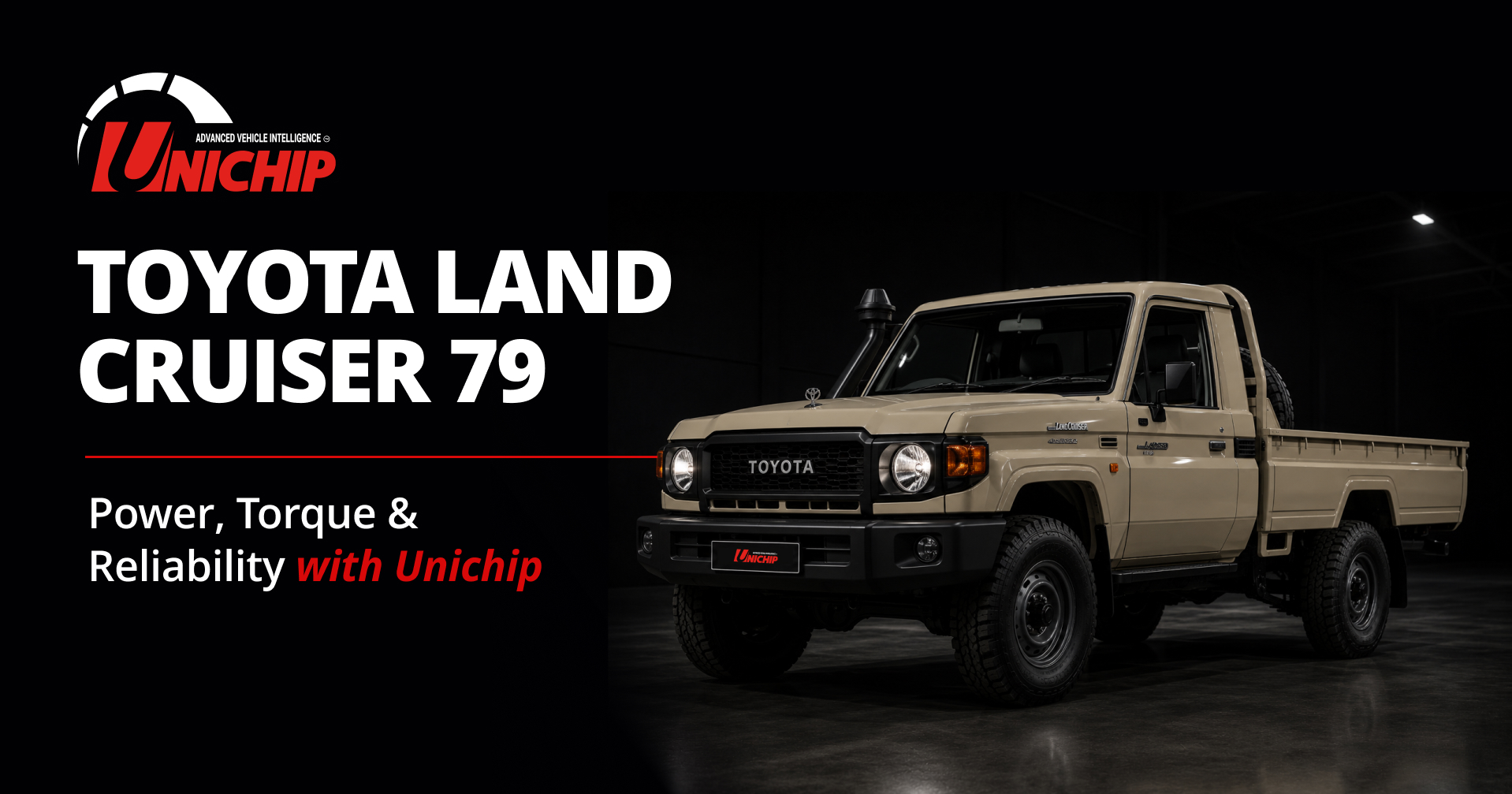
What Is Toyota Land Cruiser 79 Tuning? (Quick Definition)
Toyota Land Cruiser 79 tuning is the process of optimising engine performance, torque delivery and drivability for the way the vehicle is actually used. With a Unichip piggyback engine management system, the Land Cruiser 79 can be individually calibrated through live dyno tuning while working alongside the factory ECU rather than overwriting its original software.
For a Land Cruiser used for towing, overlanding or carrying heavy loads, the objective should be usable performance and reliability rather than maximum peak power.
Why Tune a Toyota Land Cruiser 79?
The Toyota Land Cruiser 79 Series has earned its reputation in some of the most demanding environments in the world.
These vehicles are commonly used for:
- Overlanding
- Towing
- Farming
- Mining
- Commercial work
- Off-road travel
- Long-distance touring
- Heavy load carrying
These applications also mean that many Land Cruiser 79s spend significant periods operating under sustained engine load. A properly calibrated Unichip setup can refine how the engine delivers its available performance, with particular attention given to torque, throttle response and thermal behaviour.
The goal is not to turn the Land Cruiser into something it was never designed to be. It is to make its existing performance more usable under real-world conditions.
Different Land Cruiser 79 Engines Require Different Tuning Strategies
The Land Cruiser 79 Series has been available with several different engines depending on model year and market. These include naturally aspirated and turbo-diesel configurations, as well as petrol applications.
The tuning potential and appropriate calibration strategy therefore vary considerably. A turbo-diesel Land Cruiser may have greater potential for improvements in torque and power, while naturally aspirated engines generally produce more modest gains where the focus is primarily on throttle response and drivability.
This is one reason why predetermined power claims should be treated cautiously. The correct starting point is the individual vehicle.
Land Cruiser 79 4.5 V8 Diesel Tuning
The 4.5-litre V8 turbo-diesel is one of the best-known Land Cruiser 79 engines. For owners using these vehicles for towing, touring and heavy-duty applications, outright peak horsepower is rarely the most important consideration.
A proper calibration should focus on:
- Strong usable torque
- Progressive torque delivery
- Controlled fuelling
- Stable boost
- Throttle response
- EGT management
- Performance under sustained load
The additional torque should also be introduced responsibly. Aggressive low-RPM torque can place unnecessary stress on the clutch, gearbox and drivetrain. More torque is only useful when the rest of the vehicle can manage it reliably.
Land Cruiser 79 2.8 GD-6 Tuning
The newer Toyota Land Cruiser 79 2.8 turbo-diesel automatic introduces a very different engine and drivetrain combination. The 2.8-litre GD-series engine is also familiar from other Toyota 4×4 applications, but that does not mean the same calibration should simply be transferred between vehicles.
Vehicle weight, gearing, drivetrain characteristics, intended use and operating conditions all influence how the calibration should be developed.
For the 2.8 Land Cruiser 79, live dyno tuning can focus on:
- Low- and mid-range torque
- Throttle response
- Automatic transmission behaviour
- Towing performance
- Controlled boost delivery
- EGT
- Thermal management
- Overtaking performance
The result should be stronger usable performance, rather than an aggressive calibration designed around one maximum dyno figure.
Why Torque Delivery Matters on a Land Cruiser 79
Torque is one of the biggest reasons Land Cruiser owners consider tuning. However, more torque is not automatically better. How and where the engine produces that torque is equally important.
A large torque spike at low RPM can increase stress on:
- Clutches
- Gearboxes
- Driveshafts
- Differentials
- Other drivetrain components
This becomes particularly important on modified vehicles with larger tyres, increased vehicle weight or heavy trailers. A reliability-focused tune therefore shapes torque progressively across the working RPM range. This can provide a vehicle that feels considerably stronger without relying on an unnecessarily aggressive initial torque hit.
Toyota Land Cruiser 79 Tuning for Towing
Towing places the engine under sustained load for significantly longer periods than ordinary acceleration. Consider a Land Cruiser towing a caravan or off-road trailer up a long incline. The engine may remain under high load for several minutes rather than a few seconds.
During that period:
- EGT can rise
- Coolant temperature can increase
- Intake temperatures can increase
- Turbocharger temperatures increase
- Transmission load increases
- Drivetrain stress increases
This is why a Land Cruiser towing tune should not simply be the strongest available Power Map. A dedicated Towing Map can instead prioritise controlled torque, stable boost and thermal management.
High EGT and Land Cruiser Reliability
Exhaust gas temperature is particularly important on turbo-diesel Land Cruisers operating under sustained load.
High EGT can result from factors including:
- Excessive fuelling
- Insufficient airflow
- Poor boost control
- High engine load
- Intake restrictions
- Thermal saturation
- Incorrect calibration
Allowing EGT to remain excessively high can increase thermal stress on the engine and turbocharger.
A proper dyno calibration therefore considers the relationship between fuelling, airflow, boost, torque and temperature rather than adjusting these parameters independently.
Thermal Protection with Unichip
Thermal protection becomes particularly relevant to vehicles used for towing, overlanding and heavy-duty work. Where the vehicle’s factory ECU already provides appropriate thermal protection, those strategies remain important.
However, if the factory ECU does not provide sufficient thermal protection, the Unichip can add thermal protection in different ways depending on the vehicle and application.
For example, a protection strategy can be developed to respond when monitored operating conditions move beyond the limits established by the tuner. The exact implementation depends on the specific vehicle and available engine-management signals.
This provides another tool for managing sustained-load applications where reliability is more important than maintaining maximum output regardless of temperature.
Why Live Dyno Tuning Matters
A Land Cruiser 79 should not be tuned based solely on its model designation. Even two vehicles with the same engine can produce different baseline results.
Differences may be caused by:
- Vehicle mileage
- Injector condition
- Turbo condition
- Fuel quality
- Intake restrictions
- Exhaust modifications
- Larger tyres
- Aftermarket accessories
- Engine wear
- Previous modifications
A baseline dyno test establishes how the individual vehicle is performing before additional power is requested. During live dyno tuning, the tuner can then monitor relevant parameters while applying controlled, repeatable load.
Depending on the application, this may include:
- Power
- Torque
- Boost
- AFR
- EGT
- Power delivery across the rev range
If the vehicle shows signs of an underlying mechanical problem, that problem should be addressed before pursuing additional performance. Tuning should never be used to hide a mechanical fault.
Unichip vs ECU Remapping on the Land Cruiser 79
The fundamental difference is how the engine management is modified. ECU remapping changes software within the factory ECU. The Unichip is a programmable piggyback engine management system that works alongside the original ECU.
The factory ECU software is therefore not overwritten.
This gives the Unichip approach several practical characteristics:
- Original ECU software remains intact
- Individual live dyno calibration
- Fully removable system
- Multiple maps on compatible applications
- Different calibrations for towing, economy and performance
- Additional thermal protection strategies where applicable
- Immobiliser Map functionality on compatible installations
The safety of any tuned vehicle ultimately depends on factors including vehicle condition, installation quality and calibration. The tuning method alone does not make an unsafe calibration safe.
Multi-Map Options for the Land Cruiser 79
Different driving conditions create different requirements. A vehicle towing a heavy trailer does not necessarily need the same calibration as one travelling unloaded on a highway. Compatible Unichip installations can therefore provide multiple maps.
A typical five-map configuration can include:
Immobiliser Map
Adds an additional vehicle-security layer by preventing normal engine operation when selected.
Standard Map
Provides a standard or conservative driving configuration.
Economy Map
Focuses on efficient operation under appropriate light-throttle conditions.
Towing Map
Prioritises controlled torque, load performance and thermal management.
Power Map
Provides stronger usable performance within the safe limits established during live dyno calibration.
The exact map configuration depends on the vehicle, Unichip system and owner’s requirements.
Additional Anti-Theft Protection
Land Cruisers are valuable vehicles, which makes vehicle security an important consideration for many owners. On compatible Unichip X installations, one of the available maps can be configured as a custom Immobiliser Map.
When activated, this prevents the engine from operating normally. The exact immobilisation method depends on the installation and should not be publicly disclosed.
Importantly, this does not replace the factory immobiliser, tracker, alarm or other security systems. Instead, it provides another layer of protection through the engine-management system.
Can Unichip Improve Land Cruiser 79 Fuel Consumption?
Potentially, but fuel economy requires realistic expectations.
A Land Cruiser’s fuel consumption is heavily influenced by:
- Vehicle weight
- Larger tyres
- Roof racks
- Canopies
- Bull bars
- Towing
- Terrain
- Speed
- Driving style
An Economy Map can optimise operation during appropriate light-load driving conditions. Improved torque delivery may also allow the vehicle to maintain progress with less throttle in certain circumstances. However, fuel savings cannot be guaranteed. If the additional available performance is regularly used, fuel consumption may increase.
Modified Land Cruisers Need Individual Calibration
Few Land Cruiser 79s remain completely standard.
Common modifications include:
- Larger tyres
- Raised suspension
- Bull bars
- Canopies
- Roof racks
- Long-range fuel tanks
- Exhaust systems
- Intake upgrades
- Intercoolers
- Towing equipment
These changes can alter vehicle weight, aerodynamic drag, engine load and sometimes airflow. This is another reason live tuning the actual vehicle is preferable to assuming every Land Cruiser requires exactly the same calibration. If significant engine-related modifications are made after tuning, the calibration should also be reviewed to determine whether a retune is required.
Real-World Benefits of Land Cruiser 79 Tuning
A correctly calibrated Land Cruiser 79 may provide:
- Stronger usable torque
- Improved throttle response
- Better overtaking performance
- Improved towing drivability
- More progressive power delivery
- Better response under load
- Purpose-specific map options
- Thermal management where applicable
- Optional additional immobiliser functionality
The precise results depend on the engine, vehicle condition and modifications.
For a Land Cruiser, consistency and reliability under load should remain more important than producing the largest possible dyno number.
Closing Summary
The Toyota Land Cruiser 79 is designed around durability and real-world capability. Tuning should respect those same priorities. A properly calibrated Unichip piggyback system allows torque, fuelling, boost and power delivery to be refined through live dyno tuning without overwriting the factory ECU software.
For vehicles used for towing, overlanding, touring and heavy-duty work, particular attention should be given to EGT, torque management and thermal behaviour.
The objective is straightforward:
More usable performance without unnecessarily increasing mechanical and thermal stress.
For Land Cruiser owners considering tuning, a baseline dyno assessment is often the safest place to start.
Frequently Asked Questions
Is a Unichip good for a Toyota Land Cruiser 79?
A Unichip allows the individual Land Cruiser to be calibrated through live dyno tuning while working alongside the factory ECU. It can be used to optimise torque, throttle response, load performance and other parameters depending on the engine and application.
How much power can a Unichip add to a Land Cruiser 79?
There is no single figure applicable to every Land Cruiser 79. Results vary according to engine type, vehicle condition, fuel, modifications and calibration. Baseline and tuned dyno results provide a more accurate measurement for the individual vehicle.
Can you tune a Land Cruiser 79 2.8 GD-6?
Yes. The 2.8-litre turbo-diesel Land Cruiser 79 can be calibrated with a compatible Unichip system, with tuning focused on areas such as torque delivery, throttle response, towing and usable performance.
Can you tune a Land Cruiser 79 V8 diesel?
Yes. Compatible 4.5-litre V8 turbo-diesel Land Cruiser applications can be tuned with Unichip. The appropriate configuration depends on the specific vehicle and installation.
Is Land Cruiser 79 tuning good for towing?
A towing-focused calibration can improve usable torque and drivability under load. Proper towing tuning should also consider boost stability, EGT, drivetrain load and thermal management rather than simply maximising power.
Can Unichip provide thermal protection on a Land Cruiser?
Where appropriate thermal protection already exists in the factory ECU, those strategies remain important. If sufficient factory protection is unavailable, Unichip can be configured to provide additional thermal protection in different ways depending on the application.
Does Unichip overwrite the Land Cruiser ECU?
No. Unichip is a piggyback engine management system that works alongside the factory ECU rather than flashing or overwriting its original software.
Can a Land Cruiser 79 have an Immobiliser Map?
Compatible multi-map Unichip installations can include a custom Immobiliser Map that prevents normal engine operation when selected. It provides an additional security layer rather than replacing the vehicle’s existing immobiliser, alarm or tracker.