
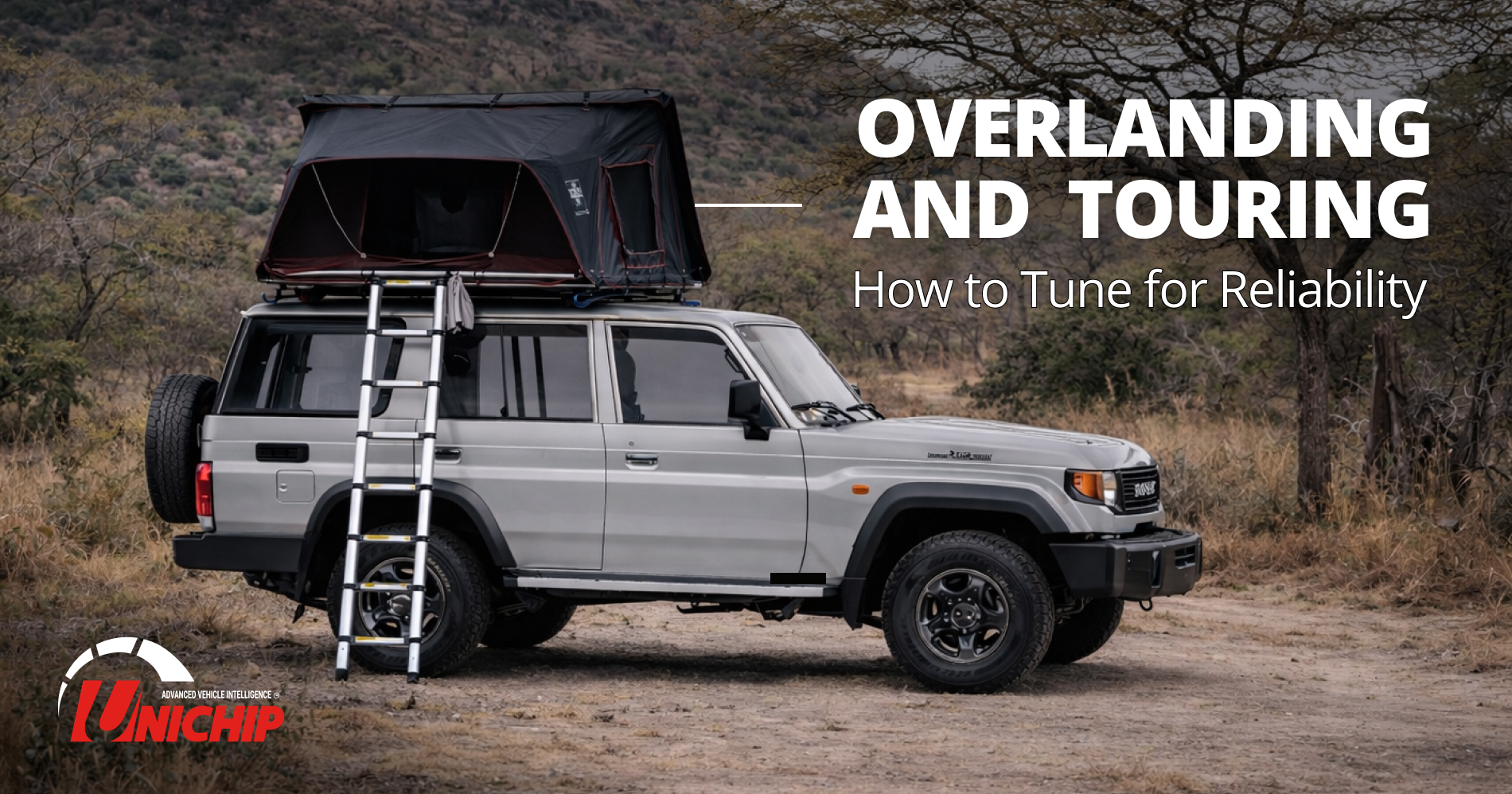
What Is an Overlanding Truck Setup?
An overlanding truck setup is a vehicle configured for long-distance, off-road travel, typically equipped with additional load such as rooftop tents, recovery gear, and storage systems. This added weight and sustained operating conditions increase engine load, making proper tuning essential to prioritise reliability, thermal control, and smooth torque delivery rather than peak power.
Introduction: Remote Travel Changes the Tuning Priorities
Overlanding and long-distance touring place different demands on a vehicle than daily commuting or short performance bursts. A well-planned overlanding truck setup often includes extended highway driving, heavy loads, rooftop tents, recovery equipment, and long climbs in high ambient temperatures, all of which increase sustained engine stress.
In these conditions, tuning should prioritise thermal control, torque management, and consistency, not peak power.
Reliability becomes more important than headline numbers when the nearest workshop may be hundreds of kilometres away.
Why Overlanding Creates Sustained Load
An overlanding truck setup typically operates under continuous load due to:
- Added vehicle mass from accessories and equipment
- Roof racks increasing aerodynamic drag
- Larger tyres altering gearing and rolling resistance
- Towing trailers or caravans
- High ambient temperatures in remote regions
These factors increase:
- Engine load percentage
- Exhaust gas temperatures (EGT)
- Cooling system demand
- Drivetrain stress
A tuning strategy that focuses only on maximum output can increase risk under these sustained conditions.
Torque Management Matters More Than Peak Power
For touring applications, smooth torque delivery is critical, especially in a fully equipped overlanding truck setup.
Abrupt torque spikes may:
- Increase gearbox and clutch stress
- Cause traction instability on loose surfaces
- Lead to ECU intervention
- Increase drivetrain wear over time
Controlled torque rise improves:
- Low-speed drivability off-road
- Throttle modulation in technical terrain
- Stability while towing
- Mechanical longevity
A reliability-focused tune shapes torque progressively rather than aggressively.
Thermal Management Under Sustained Load
Heat is the primary long-term risk during overlanding.
A heavily loaded overlanding truck setup operating under sustained conditions increases:
- Intake air temperature
- Exhaust gas temperature
- Coolant temperature
- Oil temperature
A proper touring tune should:
- Avoid unnecessary over-fuelling
- Maintain stable AFR under load
- Control boost ramp to prevent thermal spikes
- Reduce excessive cylinder pressure
Lower peak stress often translates to greater real-world consistency across long distances.
Diesel Considerations for Touring
Diesel engines are common in an overlanding truck setup due to their torque characteristics and fuel efficiency. However, they are sensitive to excessive EGT under prolonged load.
Reliability-focused diesel tuning should prioritise:
- Controlled fuelling at mid-range RPM
- Stable boost targets without overshoot
- Reduced smoke output
- Consistent torque delivery when towing
Peak dyno numbers are less important than repeatable, stable output under real conditions.
Where the Unichip Fits In
The Unichip piggyback system is particularly suited to any overlanding truck setup because it works alongside the factory ECU while retaining OEM safety strategies.
Key advantages include:
- No ECU flashing or overwriting
- Retention of factory torque limits and protections
- Live dyno tuning under controlled load
- Support for multiple maps for different use cases
- Fully removable with no electronic footprint
For touring vehicles, map configurations can be structured to prioritise:
- Standard daily driving
- Economy for long highway travel
- Towing or load-focused calibration
- Controlled power delivery when required
Each map is validated through live dyno tuning to ensure safe operation under load.
Why Dyno Tuning Is Essential for Touring Builds
Road testing cannot replicate sustained, repeatable load conditions safely, particularly in a fully equipped overlanding truck setup.
- Monitoring of AFR and EGT during extended pulls
- Verification of boost stability under simulated load
- Observation of torque delivery across the rev range
- Validation of thermal behaviour before remote travel
This controlled environment ensures that the vehicle performs predictably when exposed to real-world stress.
Practical Benefits of Reliability-Focused Tuning
When tuned for overlanding rather than peak performance, vehicles typically demonstrate:
- Improved throttle control in low-speed terrain
- Stable towing performance
- Reduced thermal stress under sustained load
- Consistent fuel consumption when driven accordingly
- Greater mechanical confidence in remote areas
These benefits are cumulative over long journeys, especially for a well-prepared overlanding truck setup.
Closing Summary
Overlanding and touring demand a different tuning philosophy. The objective is not maximum power. It is controlled, repeatable performance under sustained load.
By prioritising torque management, thermal stability, and drivability — and by retaining factory ECU protections through a Unichip piggyback system — vehicles can be optimised for reliability rather than stress.
Proper tuning for remote travel is not about pushing limits. It is about respecting them.
A dyno session is often the safest starting point before undertaking extended touring or overlanding journeys. Get in touch to arrange your dyno session today.