
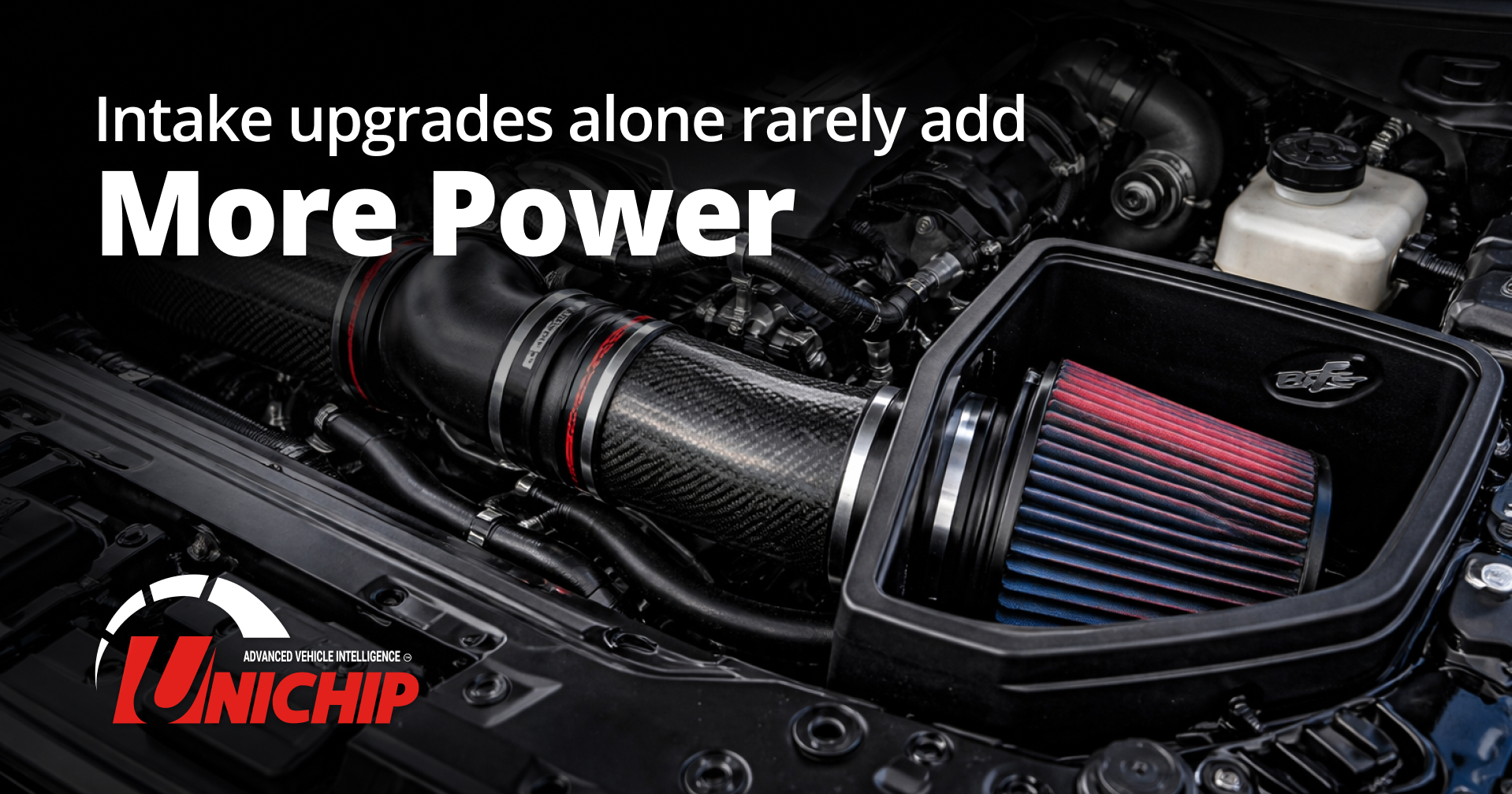
Introduction: The Intake Upgrade Expectation
Intake upgrades are often marketed as an easy way to increase power. The assumption is straightforward: improve airflow into the engine and performance will improve automatically.
In reality, intake upgrades alone rarely produce meaningful, measurable power gains on modern vehicles. The reason lies in how factory ECUs manage airflow, fuelling, and torque.
Understanding why requires looking beyond the intake hardware itself.
How Modern ECUs Control Airflow and Power
Modern engines do not produce power simply because more air is available. The factory ECU carefully controls:
- Throttle position
- Fuel delivery
- Ignition timing (petrol engines)
- Injection timing (diesel engines)
- Boost targets (turbocharged engines)
- Torque requests and limits
Even if an intake system flows more air, the ECU will not automatically inject more fuel or increase torque output unless its calibration allows it.
In most cases, the factory calibration becomes the limiting factor, not the intake hardware.
Airflow Without Calibration Changes
When an upgraded intake is installed without recalibration, several outcomes are common:
- Minimal measurable power gain
- Slight changes in throttle response feel
- Increased induction sound
- Unchanged torque delivery
On naturally aspirated engines, airflow improvements are often limited by camshaft profiles, valve timing, and exhaust flow. On turbocharged engines, boost targets remain governed by ECU logic, so airflow gains are often absorbed within existing control limits.
Without recalibration, additional airflow does not automatically translate into additional torque.
The Role of AFR and Fueling
Power increases require correct air–fuel ratio control.
If airflow increases but fuel delivery remains unchanged:
- Petrol engines may run lean under certain conditions
- Diesel engines may not increase fuel injection duration
- Combustion efficiency does not improve
- Torque output remains largely unchanged
Factory ECUs are designed to maintain safe operating parameters. They do not increase fuelling simply because airflow potential has increased.
Proper gains require coordinated adjustment of airflow and fuelling together.
Turbocharged Vehicles: Why Boost Is Still Controlled
On turbocharged engines, the ECU regulates boost pressure based on torque targets and protection strategies.
An intake upgrade may reduce restriction slightly, but:
- Boost targets remain factory-controlled
- Torque limits remain active
- Thermal management strategies remain unchanged
As a result, real-world gains from intake upgrades alone are typically small and inconsistent.
Where the Unichip Fits In
The Unichip piggyback system allows airflow upgrades to be properly calibrated without overwriting the factory ECU.
Because it works alongside the OEM ECU, the Unichip enables:
- Fuel adjustments to match improved airflow
- Controlled torque recalibration
- Boost refinement within safe limits
- Live dyno validation under load
- Retention of factory ECU safety protections
This coordinated approach ensures that airflow improvements are translated into usable, measurable torque gains rather than sound changes alone.
Why Dyno Tuning Is Essential
Without dyno validation, it is difficult to determine whether an intake upgrade provides measurable benefit.
- Monitoring of AFR stability under load
- Measurement of torque changes across the rev range
- Verification of boost behaviour
- Identification of any thermal stress increases
This data-driven process ensures upgrades contribute to performance safely and consistently.
Practical Perspective
Intake upgrades can offer benefits:
- Reduced intake restriction
- Improved throttle response feel
- Enhanced induction sound
- Support for higher power levels when properly tuned
However, expecting significant gains without recalibration is unrealistic on modern ECU-controlled engines.
Airflow potential alone does not create power. Calibration does.
Closing Summary
Intake upgrades rarely add meaningful power on their own because modern ECUs tightly control airflow, fuelling, and torque delivery.
To convert improved airflow into usable performance, calibration changes are required. When paired with live dyno tuning and a Unichip piggyback system, intake upgrades can contribute to measurable gains while retaining factory ECU protections.
Proper tuning ensures that airflow improvements result in balanced, efficient combustion rather than assumptions. A dyno session is often the most reliable way to determine whether an intake upgrade is delivering real performance benefits.
Have questions? Get in touch here.