
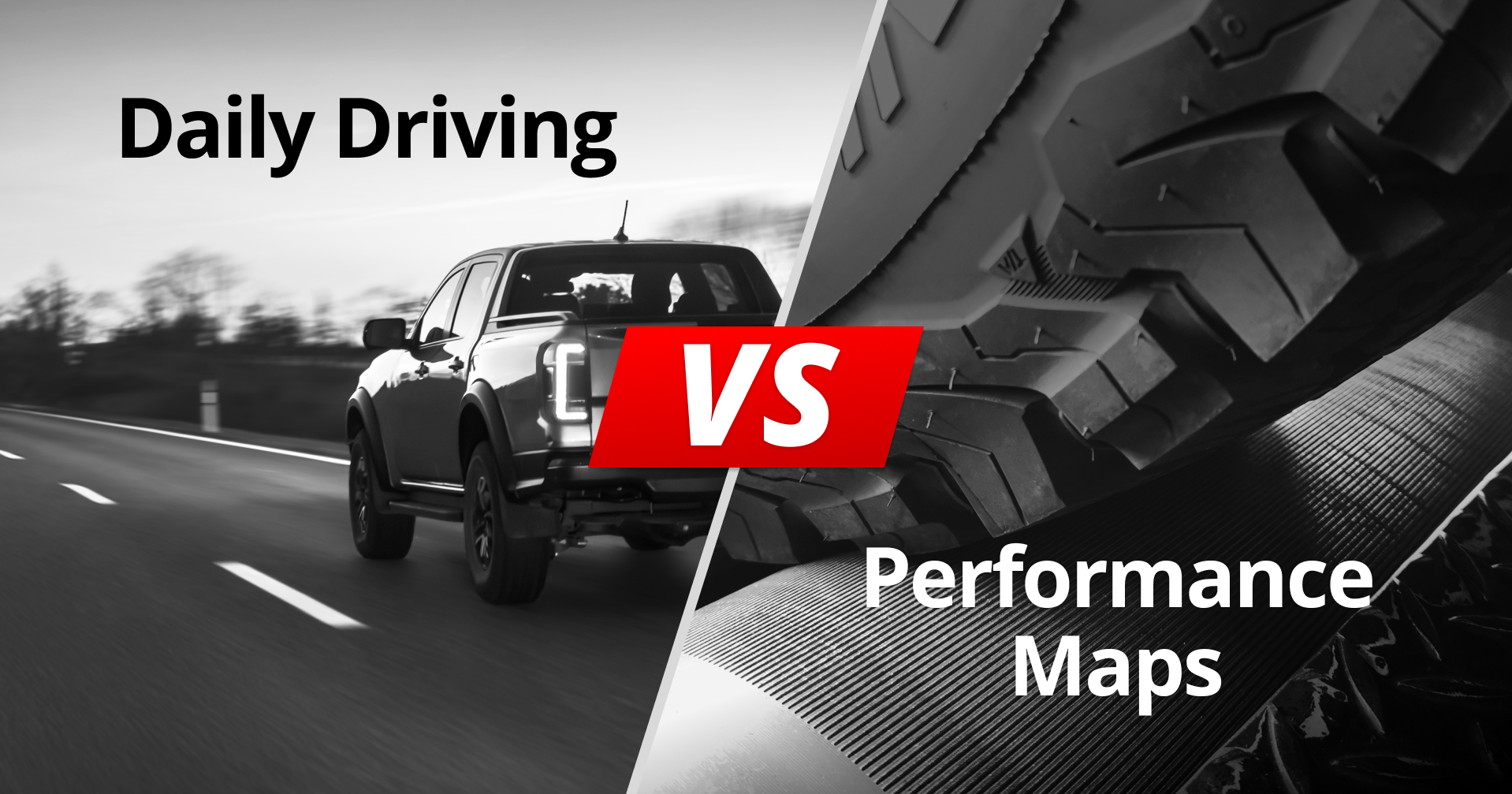
One Calibration Cannot Suit Every Scenario
Modern vehicles operate in a wide range of conditions. Daily commuting, highway cruising, towing, spirited driving, and heavy-load situations all place different demands on the engine and drivetrain.
A single calibration inevitably represents a compromise.
Multi-map tuning addresses this limitation by allowing purpose-specific calibrations that can be selected based on how the vehicle is being used. The objective is not maximum output at all times, but controlled performance aligned with real-world needs.
Why Driving Conditions Change Engine Requirements
Engine load and operating priorities vary significantly between daily driving and performance-focused use.
Daily driving typically prioritises:
- Smooth throttle response
- Predictable low-speed behaviour
- Fuel efficiency under light load
- Minimal drivetrain shock
Performance-focused driving prioritises:
- Stronger mid-range torque
- Faster boost response (turbocharged engines)
- Sharper throttle mapping
- Optimised power delivery at higher load
Attempting to merge both extremes into a single calibration often results in compromises in drivability or efficiency.
What Multi-Map Tuning Actually Changes
Multi-map tuning does not change hardware. It adjusts calibration strategies within safe parameters.
Depending on the application, map variations may include:
- Throttle sensitivity adjustments
- Torque request and delivery shaping
- Fueling refinement under specific load ranges
- Boost response behaviour (within safe limits)
- Load-based thermal management adjustments
Each map is designed for a specific operational priority rather than a universal solution.
Daily Driving Map: Control and Efficiency
A daily driving map focuses on stability and refinement.
Typical characteristics include:
- Progressive throttle response
- Smooth torque rise
- Optimised light-throttle fuelling
- Reduced driveline shock during gear changes
- Consistent behaviour in traffic conditions
The goal is predictable drivability and efficiency when driven accordingly, not aggressive response.
Performance Map: Controlled Output Under Load
A performance map prioritises stronger output under higher load conditions while remaining within safe mechanical limits.
Typical adjustments may include:
- Sharper throttle response
- Enhanced mid-range torque delivery
- Refined boost ramp (turbocharged engines)
- Optimised fuelling for sustained acceleration
Importantly, torque delivery remains controlled to avoid unnecessary drivetrain stress.
Performance maps are not designed to override factory safety strategies. They operate within them.
The Role of Torque Management in Multi-Map Systems
Torque management remains central across all maps.
Even when switching to a performance-focused calibration, the ECU’s protection strategies remain active. This ensures:
- Drivetrain protection
- Thermal stability
- Controlled cylinder pressure
- Consistent reliability
Multi-map tuning adjusts behaviour, not safeguards.
Where the Unichip Fits In
The Unichip piggyback system supports multi-map functionality by working alongside the factory ECU rather than overwriting it.
Key characteristics include:
- Fully programmable piggyback architecture
- Retention of factory ECU safety strategies
- Support for multiple calibrated maps
- Live dyno tuning validation
- Fully removable with no electronic footprint
With systems such as the Unichip X, multi-map configurations can be structured to suit different operational needs, including daily driving, economy, towing, and performance-oriented use.
Each map is developed and validated through live dyno tuning to ensure safe, repeatable behaviour under load.
Why Dyno Validation Is Essential
Switching between maps without proper load validation introduces risk.
Dyno tuning allows:
- Monitoring of AFR stability across maps
- Verification of boost consistency
- Observation of torque delivery changes
- Confirmation of thermal behaviour under sustained load
This ensures each map performs as intended without compromising reliability.
Practical Benefits of Multi-Map Tuning
When properly implemented, multi-map tuning provides:
- Greater flexibility for varying driving conditions
- Improved drivability in daily use
- Controlled performance when required
- Reduced mechanical stress during routine operation
- Increased confidence under load
The benefit is adaptability, not aggression.
Closing Summary
Daily driving and performance demands are not identical. A single calibration cannot optimise for both without compromise.
Multi-map tuning allows drivers to select purpose-specific behaviour while retaining factory ECU safety strategies. When implemented through a Unichip piggyback system and validated with live dyno tuning, this approach provides flexibility without sacrificing reliability.
Effective tuning is not about choosing between comfort and performance. It is about controlling both responsibly.
A dyno session is often the most reliable starting point when configuring multi-map tuning for real-world use.