

What Happens During a Live Dyno Tune? (Quick Definition)
A live dyno tune is the process of calibrating a vehicle under controlled load conditions while monitoring critical engine data such as air-fuel ratios, boost pressure, torque delivery, exhaust gas temperatures (EGT), and thermal behaviour. This allows tuning decisions to be based on real measurements rather than assumptions.
A Dyno Tune Is About More Than Power
Many people assume a dyno tune is simply about increasing or measuring horsepower. While performance improvements are often part of the process, a professional dyno session focuses on understanding how the engine behaves under load and ensuring it operates safely & consistently and simulates real driving conditions.
Every vehicle arrives with its own characteristics. Mileage, fuel quality, maintenance history, environmental conditions, and previous modifications all influence how an engine performs. This is why no two dyno sessions are exactly the same.
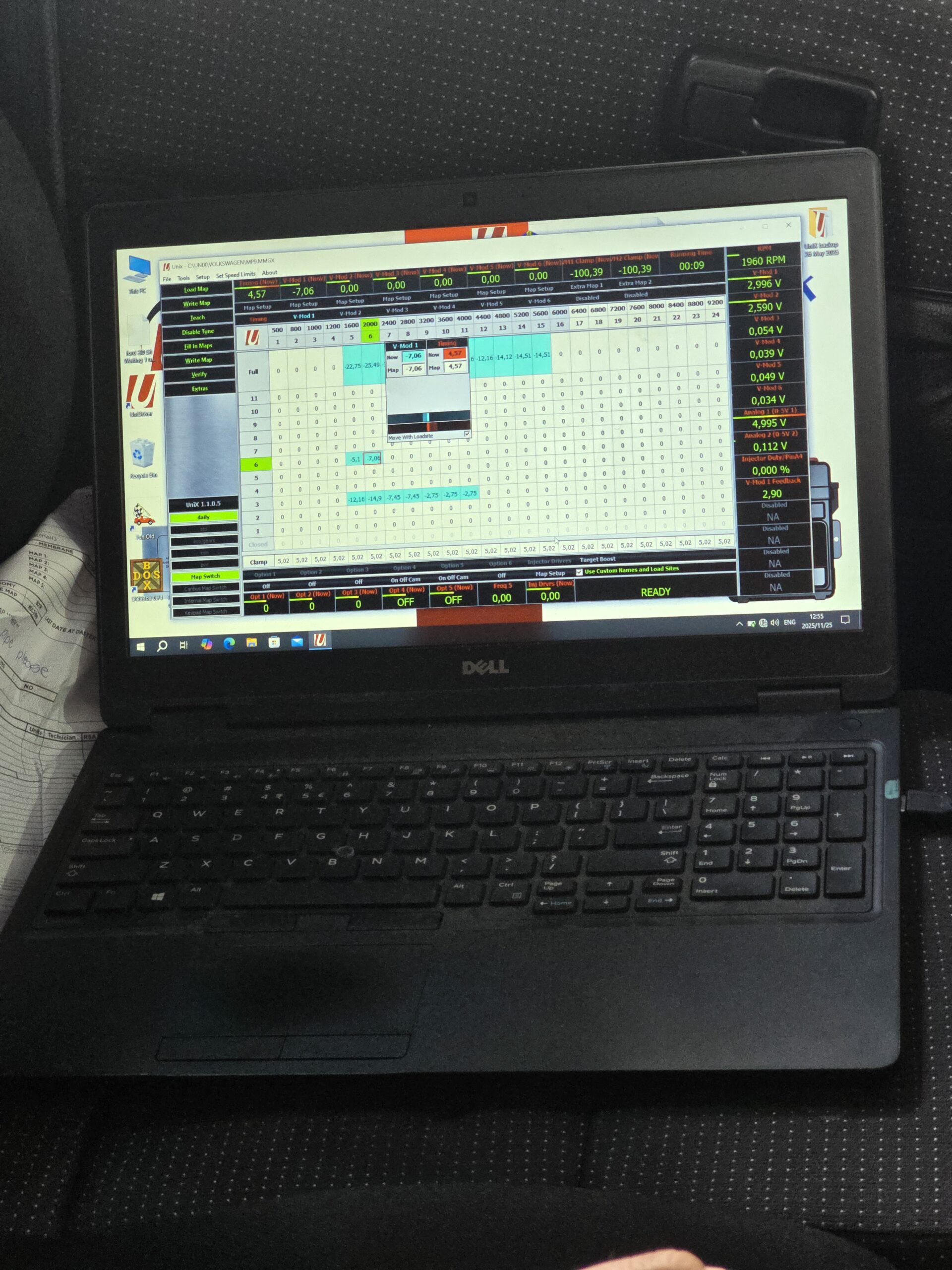
Establishing a Baseline
Before any tuning adjustments are made, the vehicle is tested in its current condition.
The baseline run allows us to measure:
- Current power output
- Torque delivery
- Air-fuel ratio behaviour
- Boost performance
- Exhaust gas temperatures
- General engine health
This provides a starting point for the tuning process and often reveals issues that may need attention before calibration begins.
Monitoring Air-Fuel Ratios (AFR)
One of the most important measurements during a dyno tune is the air-fuel ratio.
We look for:
- Stable combustion
- Appropriate fuelling under load
- Consistency across the rev range
- Safe operating conditions
Incorrect AFR values can lead to:
- Reduced performance
- Poor fuel economy
- Excessive exhaust temperatures
- Increased engine stress
Proper calibration ensures that airflow and fuel delivery remain balanced.
Evaluating Boost Control
For turbocharged vehicles, boost management is critical.
During a live dyno tune we monitor:
- Boost response
- Boost stability
- Peak boost levels
- Boost overshoot
More boost does not automatically mean more power.
Uncontrolled boost can increase:
- Cylinder pressure
- Thermal load
- Drivetrain stress
The objective is efficient airflow and controlled performance rather than simply increasing boost pressure.
Measuring Torque Delivery
Peak power figures only tell part of the story.
We pay close attention to:
- Torque progression
- Mid-range performance
- Load handling characteristics
- Drivability
Smooth torque delivery is particularly important for:
- Diesel vehicles
- Towing applications
- Overlanding setups
- Daily drivers
A progressive torque curve often produces a better driving experience than aggressive torque spikes.
Monitoring Exhaust Gas Temperatures (EGT)
EGT is one of the most valuable indicators of engine stress.
High EGT can indicate:
- Excessive fuelling
- Insufficient airflow
- Sustained engine load
- Thermal stress
Monitoring EGT helps ensure that performance gains do not come at the expense of reliability. For many diesel applications, EGT management is just as important as power output.
Evaluating Thermal Protection Strategies
Heat is one of the primary factors affecting long-term engine durability.
During a dyno tune we assess:
- Thermal stability under load
- Temperature trends during repeated runs
- Heat management during sustained operation
Many modern ECUs include factory thermal protection strategies. These systems reduce stress when temperatures rise beyond safe limits.
Where a vehicle does not have adequate thermal protection, the Unichip can add thermal protection functionality in various ways depending on the vehicle and application. This helps safeguard the engine during demanding conditions such as towing, overlanding, or prolonged high-load operation. The goal is not only performance, but long-term reliability.
Checking Fuel Economy Behaviour
For vehicles fitted with multi-map configurations, we also evaluate economy-focused calibrations.
This includes:
- Light throttle operation
- Cruise efficiency
- Torque behaviour at low load
A properly calibrated economy map can improve efficiency during everyday driving while still allowing access to performance-oriented maps when required.
Where the Unichip Fits In
The Unichip piggyback system allows precise adjustment of engine parameters while retaining factory ECU safety strategies.
Because it works alongside the ECU, we can:
- Optimise fuel delivery
- Refine boost behaviour
- Improve torque delivery
- Monitor thermal performance
- Retain OEM protections
For a full explanation, see what is a Unichip.
Why Generic Tuning Cannot Replace Live Dyno Tuning
Generic tuning files assume that every vehicle behaves the same way.
A live dyno tune measures:
- Actual vehicle condition
- Real engine behaviour
- Thermal characteristics
- Load response
This allows calibration decisions to be based on facts rather than estimates. Every vehicle is treated as an individual system.
Closing Summary
A live dyno tune is far more than a power run. It is a controlled process of measuring, analysing, and refining how a vehicle performs under load. By monitoring AFR, boost, torque delivery, EGT, and thermal protection strategies, tuning can be carried out safely and accurately.
Using a Unichip piggyback system and live dyno tuning ensures that performance improvements are achieved while maintaining reliability, drivability, and factory ECU safety strategies. Proper tuning starts with proper data.
Frequently Asked Questions
What do you monitor during a dyno tune?
A dyno tune monitors key parameters including AFR, boost pressure, torque delivery, EGT, and thermal behaviour under load.
Why is EGT important during tuning?
EGT helps identify excessive heat and engine stress, allowing calibration adjustments to maintain reliability.
Can a dyno tune identify engine problems?
Yes. Baseline dyno runs often reveal issues with fuelling, boost control, airflow, or general engine health.
Does the Unichip retain factory ECU safety systems?
Yes. The Unichip piggyback system works alongside the factory ECU and retains OEM safety strategies.
Can Unichip add thermal protection?
In applications where factory thermal protection is limited or unavailable, the Unichip can add thermal protection functionality in various ways depending on the vehicle and tuning requirements.