
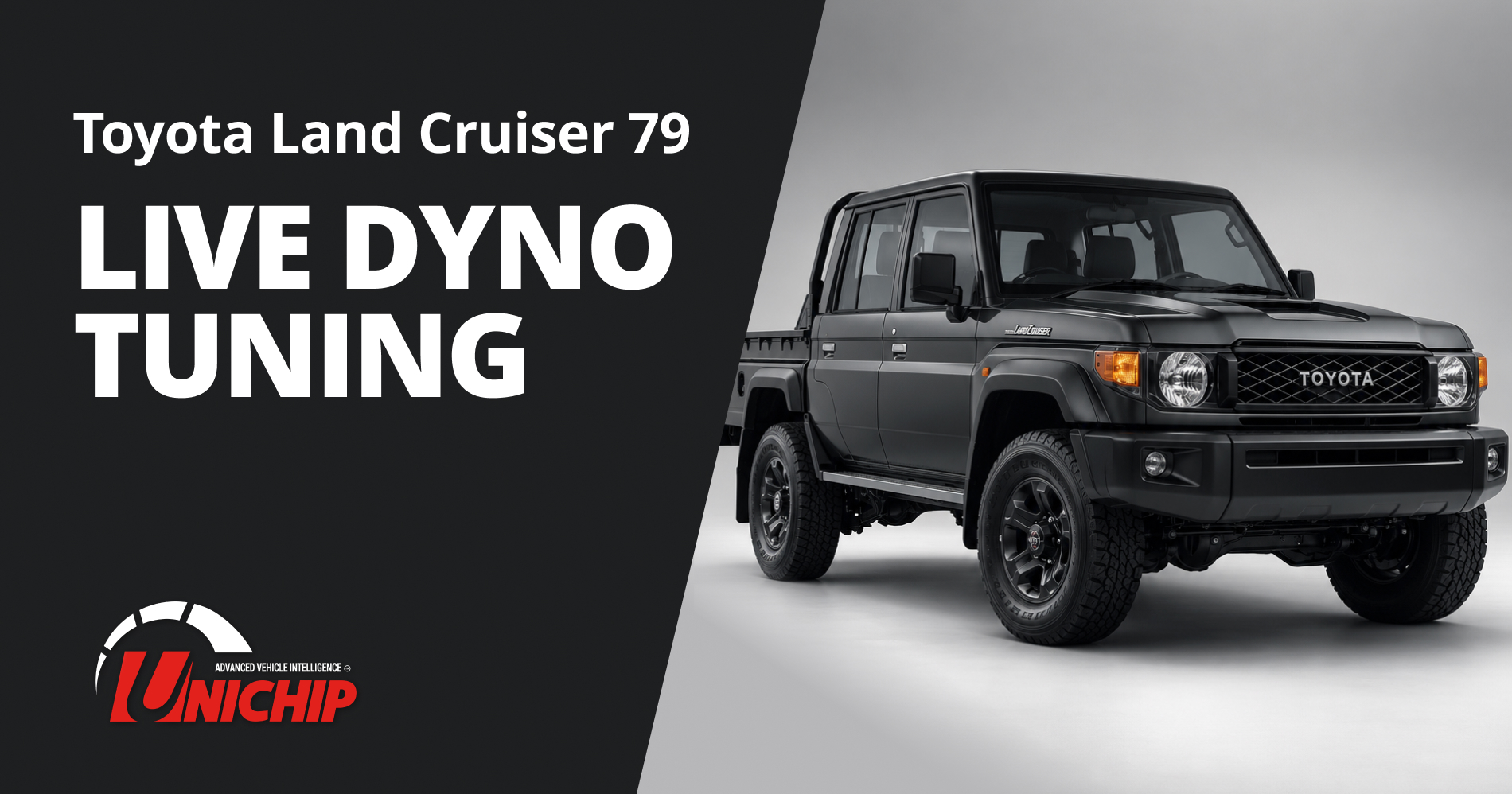
The Toyota Land Cruiser 79 2.8 GD-6 combines the proven 79 Series platform with Toyota’s modern 2.8-litre turbo-diesel engine and automatic transmission.
For owners using their Land Cruiser for towing, overlanding, work or everyday driving, peak horsepower is only part of the equation. Low-RPM response, mid-range performance and controlled torque delivery are equally important.
Real Unichip dyno testing demonstrates how individual live tuning can improve usable performance throughout the engine’s working RPM range — even on a vehicle that has already undergone aftermarket ECU software tuning.
Land Cruiser 79 2.8 GD-6 Tuning – Quick Answer
In one Toyota Land Cruiser 79 2.8 Auto i-ART, output increased from 184.3 bhp to 220.3 bhp at 3,000 rpm after Unichip installation and live dyno tuning — an improvement of approximately 20%.
Importantly, this Land Cruiser arrived with aftermarket software already loaded onto its factory ECU. Its initial dyno reading was therefore higher than would normally be expected from a standard vehicle.
The recorded improvement was measured against the vehicle’s existing software-tuned baseline, not a completely standard factory ECU calibration.
A separate 2024 Toyota Land Cruiser 2.8 i-ART Auto recorded an increase from 159.1 bhp to 212.5 bhp at 3,000 rpm (+33%), with gains of up to 40% at 4,000 rpm. These results demonstrate why individual vehicle assessment and live dyno tuning are so important.
Real Land Cruiser 79 2.8 Auto i-ART Dyno Results
The first Land Cruiser was tested and live tuned at Unichip’s head office in Pretoria, South Africa.
Important: This Land Cruiser Was Already Software Tuned
Before arriving at Unichip, this Land Cruiser 79 had already undergone aftermarket ECU software tuning. As a result, its initial dyno figures were higher than a typical factory-standard baseline.
The results below therefore compare the vehicle’s existing software-tuned performance against its performance following Unichip installation and live tuning.
Despite already having an aftermarket calibration, further improvements were recorded throughout the tested RPM range.
| RPM | Before (Already Software Tuned) | With Unichip | Gain |
| 1,500 | 88.8 bhp | 108.7 bhp | +22% |
| 2,000 | 135.5 bhp | 161.4 bhp | +19% |
| 2,500 | 169.5 bhp | 196.9 bhp | +16% |
| 3,000 | 184.3 bhp | 220.3 bhp | +20% |
| 3,500 | 165.7 bhp | 200.1 bhp | +21% |
| 4,000 | 146.3 bhp | 173.1 bhp | +18% |
At 3,000 rpm, the Land Cruiser gained 36 bhp, increasing from 184.3 bhp to 220.3 bhp.
At 1,500 rpm, output increased from 88.8 bhp to 108.7 bhp (+22%). The improvement wasn’t limited to one peak-power figure. Gains were recorded at every measured RPM point between 1,500 and 4,000 rpm.
This is particularly relevant for a working Land Cruiser, where usable performance through the lower and middle RPM range is often more valuable than maximum horsepower alone.
Another 2024 Land Cruiser 2.8 i-ART Auto Dyno Result
A separate 2024 Toyota Land Cruiser 2.8 i-ART Auto, also tested at Unichip’s Pretoria head office, produced the following results:
| RPM | Before | With Unichip | Gain |
| 1,500 | 83.2 bhp | 101.9 bhp | +23% |
| 2,000 | 125.8 bhp | 157.6 bhp | +25% |
| 2,500 | 154.7 bhp | 198.7 bhp | +29% |
| 3,000 | 159.1 bhp | 212.5 bhp | +33% |
| 3,500 | 140.8 bhp | 188.7 bhp | +34% |
| 4,000 | 118.7 bhp | 166.3 bhp | +40% |
At 3,000 rpm, this vehicle gained 53.4 bhp, increasing from 159.1 bhp to 212.5 bhp.
The largest percentage improvement was recorded at 4,000 rpm, where output increased by approximately 40%.
Why Were the Results Different?
The two Land Cruisers started from different performance levels. The first vehicle arrived with aftermarket ECU software already installed, resulting in a higher initial power output. The second vehicle had a lower baseline and recorded larger percentage improvements at several RPM points.
These results highlight an important principle:
Two Land Cruisers with the same engine won’t necessarily produce identical tuning gains.
Existing software, vehicle condition, modifications, fuel and other factors can influence both baseline performance and the final result.
That’s why Unichip focuses on testing and calibrating the individual vehicle rather than promising one fixed percentage gain.
Why Low- and Mid-Range Performance Matters on the LC79
The Land Cruiser 79 is designed to work. Whether carrying equipment, towing a trailer or travelling with additional overlanding accessories, the vehicle frequently operates under substantial load.
In these situations, performance through the lower and middle RPM range is particularly important.
A well-developed Unichip calibration can focus on:
- Stronger low-RPM response
- Improved mid-range acceleration
- Progressive torque delivery
- Better throttle response
- More usable performance under load
Most everyday driving doesn’t happen at 100% throttle.
This is why looking at the complete dyno curve is more useful than focusing only on the highest horsepower figure.
Live Dyno Tuning the Land Cruiser 2.8 GD-6
Unichip is a programmable piggyback engine management system that works alongside the Toyota factory ECU rather than flashing or overwriting its original software.
During live dyno tuning, the vehicle is tested under controlled load while the calibration is developed for that individual Land Cruiser.The process can include optimising fuelling, boost and performance delivery while considering the vehicle’s mechanical condition and intended use.
This is especially relevant when a vehicle has already been modified or previously software tuned. Tuning should never be used to hide a mechanical fault. A baseline assessment helps establish how the vehicle is performing before additional performance is requested.
LC79 Tuning for Towing and Heavy Loads
Additional usable torque can make a difference when towing, climbing gradients or travelling with substantial vehicle weight. However, simply producing the highest possible torque figure shouldn’t be the objective.
A towing-focused calibration should prioritise progressive torque delivery, usable performance and appropriate thermal management. When a turbo-diesel operates under sustained load, exhaust gas temperature (EGT) and other operating temperatures become important considerations.
Many modern ECUs include factory thermal protection strategies. Where factory thermal protection is limited or unavailable, Unichip can add thermal protection functionality in different ways depending on the vehicle and application.
The objective is to improve performance while respecting the engine’s operating limits.
Multiple Unichip Maps for Different Driving Requirements
Compatible Land Cruiser 79 Unichip installations can provide selectable maps for different applications.
A typical five-map configuration may include:
- Immobiliser Map
- Standard Map
- Economy Map
- Towing Map
- Power Map
This flexibility is useful for owners who use the same Land Cruiser for commuting, towing, work and off-road travel.
On compatible Unichip X installations, the Immobiliser Map can prevent normal engine operation when selected. It complements the vehicle’s existing security systems rather than replacing them.
Exact map functionality depends on the vehicle and installation.
Does Unichip Remap the Factory ECU?
No. Unichip works alongside the factory ECU as an external piggyback engine management system. Unlike conventional ECU remapping, it does not flash or overwrite the original factory ECU software.
With an appropriate X-Connect installation, the Unichip system is also removable.
Physical evidence of installation may still be identifiable, so removability shouldn’t be interpreted as meaning a modification can never be detected.
For the first Land Cruiser featured in this article, it’s also important to distinguish the Unichip installation from the aftermarket ECU software that was already present when the vehicle arrived.
The Result: Two Land Cruisers, Two Different Starting Points
The two real 2.8-litre Land Cruiser dyno tests demonstrate the value of individual calibration.
Land Cruiser 79 2.8 Auto i-ART — Previously Software Tuned
184.3 → 220.3 bhp at 3,000 rpm (+20%)
2024 Land Cruiser 2.8 i-ART Auto
159.1 → 212.5 bhp at 3,000 rpm (+33%)
Both vehicles recorded improvements throughout the tested RPM range, but their starting points and final results were different. The first example is particularly interesting because the vehicle already had aftermarket ECU software installed before Unichip tuning.
For Land Cruiser owners, the most important question isn’t simply how much additional horsepower can be achieved. It’s how that performance is delivered, where the gains occur and how the calibration suits the individual vehicle.
A baseline dyno assessment is the best starting point for understanding what your Land Cruiser can achieve.
Frequently Asked Questions
How much power can Unichip add to a Land Cruiser 79 2.8 GD-6?
In one Land Cruiser 79 2.8 Auto i-ART test, output increased from 184.3 bhp to 220.3 bhp at 3,000 rpm, an improvement of approximately 20%. However, this particular vehicle arrived with aftermarket ECU software already installed, meaning its initial power output was higher than standard. The improvement was measured against that existing software-tuned baseline, not the original factory calibration.
Can Unichip improve a Land Cruiser that has already been software tuned?
Potentially, yes. The documented LC79 arrived with aftermarket ECU software already installed and recorded further performance improvements following Unichip installation and live tuning.
Results depend on the existing calibration, vehicle condition and tuning requirements.
Is Unichip suitable for towing with a Land Cruiser 79?
Yes. A vehicle-specific towing calibration can focus on progressive torque delivery, low- and mid-range performance and thermal management rather than maximum peak power alone.
Does Unichip remap the Land Cruiser ECU?
No. Unichip is a programmable piggyback engine management system that works alongside the factory ECU rather than flashing or overwriting its original software.
Can the Land Cruiser 79 have different Unichip maps?
Compatible installations can provide multiple maps. A typical five-map configuration includes Immobiliser, Standard, Economy, Towing and Power maps.
Are these Land Cruiser power gains guaranteed?
No. These are results from individual tested vehicles. Existing ECU software, baseline performance, mechanical condition, modifications and other factors can influence the final results.