
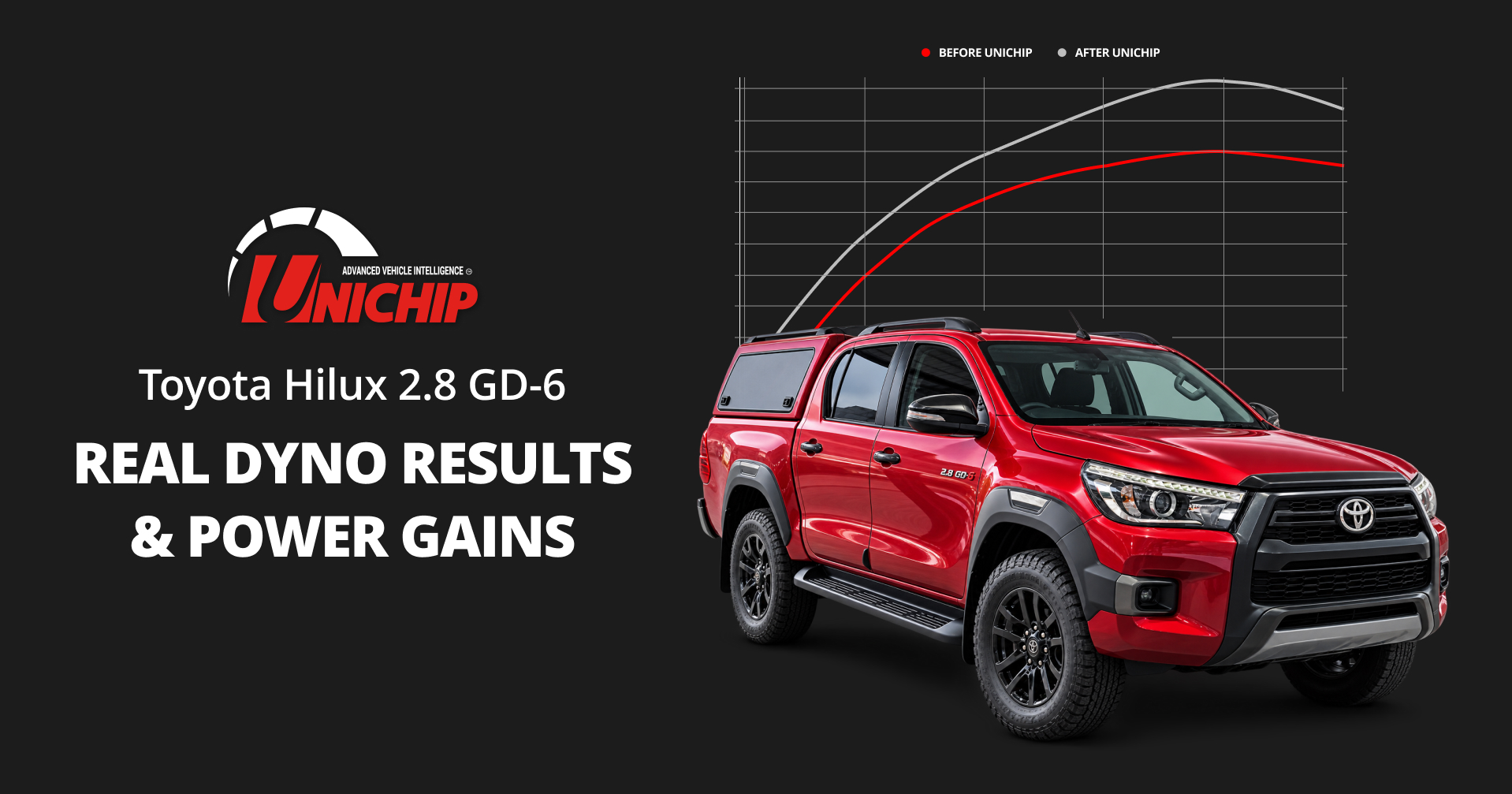
Toyota Hilux 2.8 GD-6 Tuning – Quick Answer
Toyota Hilux 2.8 GD-6 tuning with Unichip can improve power delivery, usable torque, throttle response and performance under load. Rather than applying a predetermined power increase, Unichip tuning starts with a baseline dyno test and calibrates the individual Hilux under controlled load.
Real Unichip dyno results across several versions of the Hilux 2.8 GD-6 show gains at 3,000 rpm ranging from 22% to 36% on the vehicles tested, demonstrating both the tuning potential of the GD-6 platform and why results should be measured individually.
Why Tune the Toyota Hilux 2.8 GD-6?
The 2.8 GD-6 turbo-diesel is used across numerous Hilux generations and specifications, from earlier 130kW models through to newer 150kW, GR Sport, Legend 55 and 48V variants. These vehicles are also frequently expected to do considerably more than ordinary daily driving.
Hilux owners use them for:
- Towing caravans and trailers
- Carrying heavy loads
- Overlanding
- Off-road driving
- Long-distance touring
- Commercial and agricultural work
For these applications, the objective of tuning should not simply be the largest possible peak horsepower figure. Usable low- and mid-range performance is often far more valuable.
Real Toyota Hilux 2.8 GD-6 Dyno Results
We have live dyno tuned several different versions of the Toyota Hilux 2.8 GD-6, giving us useful real-world evidence of how the platform responds to Unichip calibration.
Here are some of those results at 3,000 rpm:
| Toyota Hilux 2.8 GD-6 | Standard | Unichip | Gain |
| 130kW Auto | 135.9 bhp | 181.6 bhp | +34% |
| 150kW | 159.1 bhp | 206.0 bhp | +29% |
| Auto 1GD | 147.8 bhp | 201.0 bhp | +36% |
| Legend 55 2025 | 176.0 bhp | 221.2 bhp | +26% |
| GR Sport III 2024 | 178.3 bhp | 229.9 bhp | +29% |
| GR Sport III | 172.2 bhp | 215.5 bhp | +25% |
| 48V | 172.0 bhp | 210.6 bhp | +22% |
These are results from individual vehicles and dyno sessions, not guaranteed performance figures for every Hilux 2.8 GD-6.
What makes the data particularly useful is the variation between vehicles. It demonstrates why a claim such as “a Unichip adds X horsepower to a Hilux” is too simplistic. Different versions of the GD-6 have different factory outputs, while vehicle condition, fuel, modifications and other variables can influence the final result.
Hilux 2.8 GD-6 130kW Auto Dyno Results
The Hilux 2.8 GD-6 130kW Auto provides a good example of why looking beyond peak power matters.
The recorded results were:
| RPM | Standard | Unichip | Gain |
| 2,000 | 116.0 bhp | 139.2 bhp | +20% |
| 2,500 | 135.3 bhp | 182.7 bhp | +35% |
| 3,000 | 135.9 bhp | 181.6 bhp | +34% |
| 3,500 | 121.4 bhp | 159.0 bhp | +31% |
| 4,000 | 98.8 bhp | 138.4 bhp | +40% |
At just 2,500 rpm, the tuned vehicle was already producing 182.7 bhp compared with 135.3 bhp in standard form. That type of mid-range improvement is particularly relevant to overtaking, towing and accelerating under load.
Hilux 2.8 GD-6 150kW Dyno Results
The newer Hilux 2.8 GD-6 150kW also produced strong results.
| RPM | Standard | Unichip | Gain |
| 2,000 | 125.1 bhp | 154.3 bhp | +23% |
| 2,500 | 156.9 bhp | 203.3 bhp | +30% |
| 3,000 | 159.1 bhp | 206.0 bhp | +29% |
| 3,500 | 143.2 bhp | 183.5 bhp | +28% |
| 4,000 | 125.4 bhp | 166.7 bhp | +33% |
One of the interesting results here is that the tuned Hilux produced 154.3 bhp at only 2,000 rpm, approaching the vehicle’s standard 159.1 bhp output recorded at 3,000 rpm. Again, that demonstrates why the shape of the power delivery can matter more to everyday driving than a single peak figure.
Why Mid-Range Gains Matter on a Hilux
A Hilux spends relatively little time operating at maximum engine speed during normal use. For towing, overtaking and carrying loads, performance between approximately 2,000 and 3,500 rpm is particularly useful.
Improving performance through this area can result in:
- Stronger acceleration
- Better response when overtaking
- Improved pulling ability
- Less effort when climbing gradients
- Better performance when loaded
- More confident towing
The objective is therefore to create a strong, progressive power curve, rather than simply chasing the highest possible dyno number.
Torque Delivery Matters Too
Additional diesel torque can make a Hilux feel dramatically stronger, but how that torque arrives is important. An unnecessarily aggressive low-RPM torque spike can place additional stress on the transmission and drivetrain.
A proper calibration should instead aim for progressive and usable torque delivery through the working rev range. This is one of the advantages of calibrating the actual vehicle under load rather than relying only on a generic performance figure.
How Unichip Tunes the Hilux 2.8 GD-6
The Unichip is a programmable piggyback engine management system. It works alongside the Toyota factory ECU rather than flashing or overwriting its original software.
A baseline dyno run is performed first to establish how the individual Hilux behaves in standard form. The Unichip can then be live calibrated under controlled load.
Depending on the vehicle and available instrumentation, the tuner can evaluate parameters such as:
- Power
- Torque
- Boost
- Fuelling
- AFR
- EGT
This also provides an opportunity to identify abnormal behaviour before additional performance is pursued. Tuning should never be used to hide an existing mechanical problem. For a deeper explanation of the process, see our guide to Live Dyno Tuning.
Hilux 2.8 GD-6 Tuning for Towing
Towing is one of the most common reasons Hilux owners look for additional performance. A caravan or heavy trailer increases engine load substantially, particularly during long climbs and overtaking.
A towing-focused calibration should therefore prioritise:
- Progressive torque delivery
- Strong mid-range performance
- Stable boost
- Controlled fuelling
- Predictable throttle response
- Thermal management
On compatible Unichip installations, a dedicated Towing Map can be calibrated specifically for this type of use.
EGT and Thermal Protection
Thermal behaviour becomes increasingly important when a turbo-diesel operates under sustained load. Towing, overlanding and prolonged uphill driving can increase exhaust gas temperature and place additional thermal load on the engine and turbocharger.
Many modern ECUs include factory thermal protection strategies. Where factory thermal protection is limited or unavailable, the Unichip can add thermal protection functionality in different ways depending on the vehicle and application.
This is why monitoring the vehicle under load forms an important part of a reliability-focused tuning strategy.
Different Maps for Different Hilux Applications
Compatible Unichip X installations can also provide multiple calibrations for different driving requirements.
A typical five-map setup can include:
- Immobiliser Map
- Standard Map
- Economy Map
- Towing Map
- Power Map
This allows a Hilux used for several different purposes to have calibrations suited to those applications.
For example, the Power Map can prioritise maximum safe performance, while the Towing Map can focus more heavily on controlled torque delivery and sustained-load operation. The Immobiliser Map provides an additional anti-theft layer on compatible installations by preventing normal engine operation when selected. The precise immobilisation method varies by installation and is intentionally not publicly disclosed.
Can Hilux 2.8 GD-6 Tuning Improve Fuel Economy?
It can under the right conditions, but fuel savings should not be guaranteed. An Economy Map can optimise the calibration for appropriate light-throttle and cruising conditions, while improved torque delivery may also change how much throttle is required during normal driving.
Actual fuel consumption still depends heavily on:
A driver who frequently uses the additional available performance may see no fuel saving at all.
What About Modified Hilux GD-6 Vehicles?
Many Hilux vehicles are modified with larger tyres, canopies, roof racks, bull bars, exhaust systems, intake modifications and other accessories.
These changes can affect vehicle weight, airflow or engine load.
Live dyno tuning allows the calibration to be developed around the vehicle in its current configuration.
If significant engine-related modifications are made after the vehicle has been tuned, another dyno assessment can determine whether the Unichip calibration needs to be adjusted.
What Do the Dyno Results Tell Us?
Across the Hilux 2.8 GD-6 vehicles documented here, the results demonstrate three important points. First, the GD-6 platform has shown strong tuning potential across several different versions. Second, meaningful gains are present throughout the working rev range rather than only at peak power.
Most importantly, the results are not identical. At 3,000 rpm, the examples in our records range from a 22% improvement on the 48V Hilux to a 36% improvement on the Auto 1GD tested. That is exactly why Unichip tuning is based on measuring and calibrating the individual vehicle.
Closing Summary
The Toyota Hilux 2.8 GD-6 has demonstrated substantial tuning potential across multiple generations and specifications. Our recorded dyno results include a 130kW Auto increasing from 135.9 to 181.6 bhp at 3,000 rpm, a 150kW model increasing from 159.1 to 206.0 bhp, and a 2025 Legend 55 increasing from 176.0 to 221.2 bhp at the same engine speed. But the variation between those results is just as important as the gains themselves.
A proper Hilux tune should begin with the vehicle in front of the tuner, establish its baseline performance and then develop the calibration around its condition, configuration and intended use. With Unichip, the focus remains on measurable, usable performance through live dyno tuning rather than promising one generic power figure for every Hilux.
Frequently Asked Questions
How much power does a Unichip add to a Toyota Hilux 2.8 GD-6?
There is no single guaranteed power increase. In the Hilux 2.8 GD-6 examples documented here, gains at 3,000 rpm ranged from approximately 22% to 36%. The result for an individual Hilux depends on its specification, condition and calibration.
What are the dyno results for a Hilux 2.8 GD-6 130kW Auto?
The vehicle tested produced 135.9 bhp at 3,000 rpm in standard form and 181.6 bhp after Unichip calibration, an increase of 34% at that engine speed.
What are the dyno results for the Hilux 2.8 GD-6 150kW?
The 150kW Hilux documented in our results produced 159.1 bhp at 3,000 rpm before tuning and 206.0 bhp after Unichip live tuning, an increase of 29%.
Does Unichip remap the Toyota Hilux ECU?
No. Unichip is a piggyback engine management system that works alongside the factory ECU rather than flashing or overwriting its original software.
Is Unichip suitable for towing with a Hilux 2.8 GD-6?
A compatible Unichip installation can include a dedicated Towing Map focused on progressive torque, usable mid-range performance and thermal management under sustained load.
Can tuning improve Hilux 2.8 GD-6 fuel consumption?
An Economy Map may improve efficiency under appropriate driving conditions, but there is no guaranteed fuel-saving percentage. Driving style, tyres, load, towing and other factors all influence consumption.