
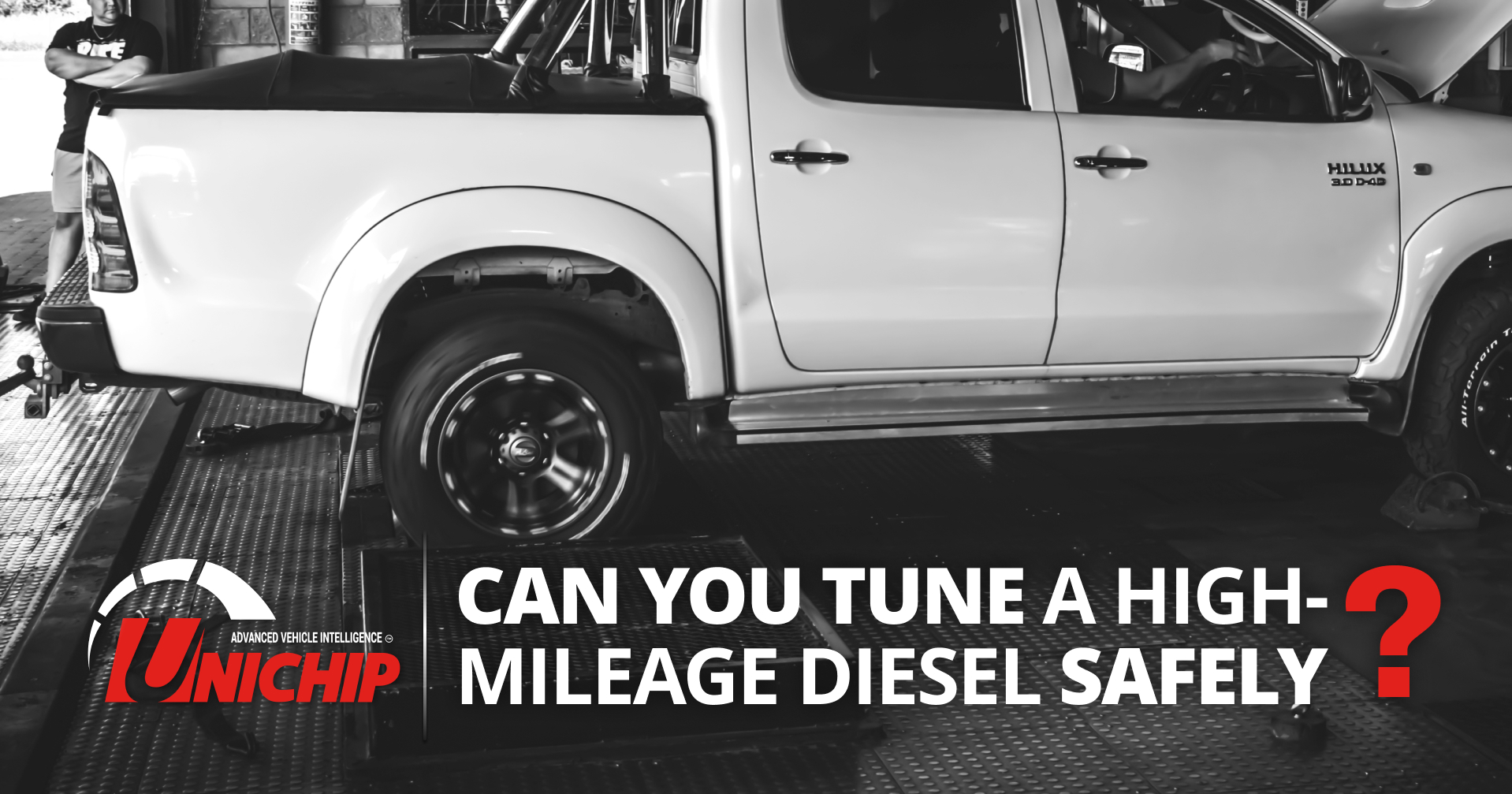
A diesel engine doesn’t automatically become unsuitable for performance tuning simply because it has covered a lot of kilometres. But there’s an important difference between tuning a relatively new vehicle and one that has already travelled 200,000 km or more.
Over time, components wear, parts get replaced, and engines develop their own operating characteristics. Two vehicles that were identical when they left the factory may perform quite differently after years of use.
That’s why high-mileage diesel tuning should start with the vehicle itself, not a predetermined tuning file.
With Unichip, the individual vehicle can be assessed and live tuned on the dyno, allowing the calibration to be developed around how that engine actually performs today.
Can You Safely Tune a High-Mileage Diesel?
Yes, a high-mileage diesel can potentially be tuned safely, provided the engine and supporting components are in good mechanical condition.
There is no universal mileage limit beyond which a diesel cannot be tuned. A well-maintained vehicle with 250,000 km may be a better candidate than a neglected vehicle with half that mileage.
What matters is the condition of the engine, turbocharger, fuel system, cooling system and drivetrain. Before additional performance is requested, the vehicle should be assessed to establish whether it is mechanically suitable.
Tuning should never be used to hide a mechanical fault.
Why Older Diesel Engines Are Different
Consider two identical diesel bakkies that left the factory with the same engine and ECU calibration. Years later, one has covered 80,000 km while the other has travelled 250,000 km. The higher-mileage vehicle may have had its injectors replaced, turbocharger repaired, sensors changed or other components renewed during its lifetime.
Even when replacement parts meet the correct specifications, differences in component condition, wear and previous repairs can influence how the engine performs. The two vehicles may now respond differently to the same tuning adjustments.
This is where individual vehicle calibration becomes particularly important.
A calibration developed for one vehicle shouldn’t automatically be assumed to be ideal for another, especially when their mechanical histories differ.
Why a Generic Tuning File May Not Be the Best Approach
Many modern vehicles can be tuned by modifying the calibration stored in the factory ECU. ECU remapping can be effective when performed correctly, particularly when the tuner assesses the vehicle and develops the calibration around its actual performance. However, not every tuning process involves that level of individual assessment.
Some approaches rely on predetermined calibration files developed for a particular engine or model, with limited testing or adjustment on the vehicle receiving the tune. That approach may not fully account for differences caused by mileage, component replacement, previous modifications or general mechanical condition.
Even a well-developed calibration file may need adjustment to suit an older vehicle’s individual characteristics. The important distinction isn’t simply whether a vehicle has been remapped. It’s whether the calibration has been verified and optimised on that particular vehicle.
This is where Unichip’s live tuning capability becomes especially valuable.
The Unichip Advantage: Live Tuning the Vehicle in Front of You
Unichip is a programmable piggyback engine management system that works alongside the vehicle’s factory ECU rather than flashing or overwriting its original software.
Instead of relying solely on a predetermined calibration, a trained Unichip tuner can make adjustments while the individual vehicle is operating under controlled load on the dyno.
This allows the tuner to evaluate how the engine responds and refine the calibration accordingly.
Depending on the vehicle and application, the process can involve assessing:
- Fuelling and air-fuel behaviour
- Turbo boost and engine response
- Low- and mid-range performance
- Torque delivery
- Performance under load
- Relevant engine protection parameters
The benefit is particularly relevant to older vehicles because the calibration can be developed around their current mechanical characteristics, rather than assuming they still behave exactly as they did when new.
Unichip’s ability to make live adjustments is not exclusive to piggyback tuning — experienced ECU remappers can also perform individual live calibration. The difference is that Unichip provides this capability through a programmable system working alongside the original ECU software.
Why a Baseline Dyno Test Matters
Before tuning an older diesel, it’s important to establish how the vehicle is currently performing. A baseline dyno test can help identify unusual power delivery, inconsistent performance or other behaviour that may require investigation.
For example, if a diesel is producing considerably less power than expected, the answer isn’t necessarily to increase fuelling or boost. There may be an underlying problem with the turbocharger, fuel system, airflow or another component.
A dyno assessment is useful, but it doesn’t replace a proper mechanical inspection or diagnostic testing. The vehicle needs to be healthy before additional performance is requested. Once its condition has been assessed, the tuner can establish a sensible calibration strategy.
More Power Isn’t Always Better on an Older Diesel
For a high-mileage diesel, maximum horsepower shouldn’t necessarily be the priority. An older bakkie used for towing or everyday driving may benefit more from improved throttle response, stronger mid-range performance and progressive torque delivery.
Increasing torque aggressively at low RPM can also place additional load on components such as the clutch, automatic transmission and drivetrain. A carefully developed calibration should consider these limitations rather than simply pursuing the highest possible dyno figure.
Peak power isn’t everything. How the vehicle delivers that power matters just as much.
Towing, EGT and Engine Protection
Many older diesel vehicles are still working hard every day. They may regularly tow trailers, carry equipment or travel long distances with additional overlanding weight.
These activities place sustained load on the engine, making thermal management particularly important. Exhaust gas temperature (EGT), boost and other operating temperatures should be considered when developing a towing calibration.
Many modern ECUs include factory thermal protection strategies. Where factory thermal protection is limited or unavailable, Unichip can add thermal protection functionality in different ways depending on the vehicle and application.
For a high-mileage diesel, the objective should be usable performance that respects the condition and operating limits of the vehicle.
When Should You Avoid Tuning a High-Mileage Diesel?
If a vehicle already has mechanical problems, those problems should be addressed before tuning. Warning signs include excessive smoke, overheating, abnormal oil consumption, inconsistent boost, injector problems, unusual engine noises or transmission issues.
Additional performance can increase mechanical and thermal loads, potentially making existing weaknesses more serious. A responsible tuner should be prepared to recommend repairs or decline tuning if the vehicle isn’t mechanically suitable.
High Mileage Doesn’t Mean You Can’t Improve Performance
A diesel with 200,000 or 300,000 km isn’t automatically too old to tune. But its history matters. After years of use, component replacement, repairs and wear, it may no longer behave exactly like another vehicle of the same model. That’s why Unichip’s approach to individual live dyno tuning is particularly relevant to high-mileage vehicles.
Rather than assuming every engine needs the same calibration, the tuner can assess the actual vehicle, understand its current performance and develop an appropriate setup.
The condition of the vehicle should determine the tune — not just the number on the odometer.
Frequently Asked Questions
Can you tune a diesel with 200,000 km?
Yes, potentially. Mileage alone doesn’t determine whether a diesel can be tuned. Mechanical condition, maintenance history and the health of the engine and drivetrain are more important.
Why is live dyno tuning important for older diesel vehicles?
Older vehicles may have worn components, replacement parts or previous modifications that affect performance. Live dyno tuning allows the calibration to be assessed and adjusted according to how the individual vehicle actually responds.
Is a generic remap suitable for a high-mileage diesel?
A predetermined remap may not fully account for an older vehicle’s individual mechanical condition. A vehicle-specific calibration that is tested and refined under load is preferable, regardless of the tuning technology used.
Does Unichip overwrite the factory ECU software?
No. Unichip is a programmable piggyback engine management system that works alongside the factory ECU without flashing or overwriting its original software.
Can Unichip improve towing performance on an older diesel?
Potentially, yes. A suitable calibration can focus on usable low- and mid-range performance, progressive torque delivery and thermal management. The vehicle must first be mechanically suitable for tuning.
Can tuning damage a high-mileage diesel?
Increasing performance can place additional load on the engine and drivetrain. The risks depend on mechanical condition, calibration quality, operating limits and how the vehicle is used. Existing mechanical faults should be addressed before tuning.